TL Compliance Suite


The TOLERANT Compliance Suite helps organisations reliably screen customers, suppliers, partners, payees and business contacts against relevant sanctions lists and risk data sources. These include, amongst others, sanctions lists, PEP lists, custom lists, as well as risk data sources. From data import through error-tolerant screening to business decisions, risk assessment and audit-proof documentation, the Compliance Suite maps out an end-to-end compliance process — automated, traceable and scalable.
With a view to the EU Anti-Money Laundering Regulation (AMLR), which comes into force on 10 July 2027, the TL Compliance Suite is being specifically enhanced with additional functions for risk-based anti-money laundering prevention. Planned features include, amongst others, a traceable customer risk classification, the workflow-supported implementation of customer due diligence measures, the recording and assessment of beneficial owners, systematic review and resubmission management, and event-driven monitoring of customers and business relationships.
As a result, the TL Compliance Suite is evolving from a powerful screening and compliance platform into a comprehensive working environment for risk-based verification, decision-making and documentation processes within the framework of anti-money laundering.
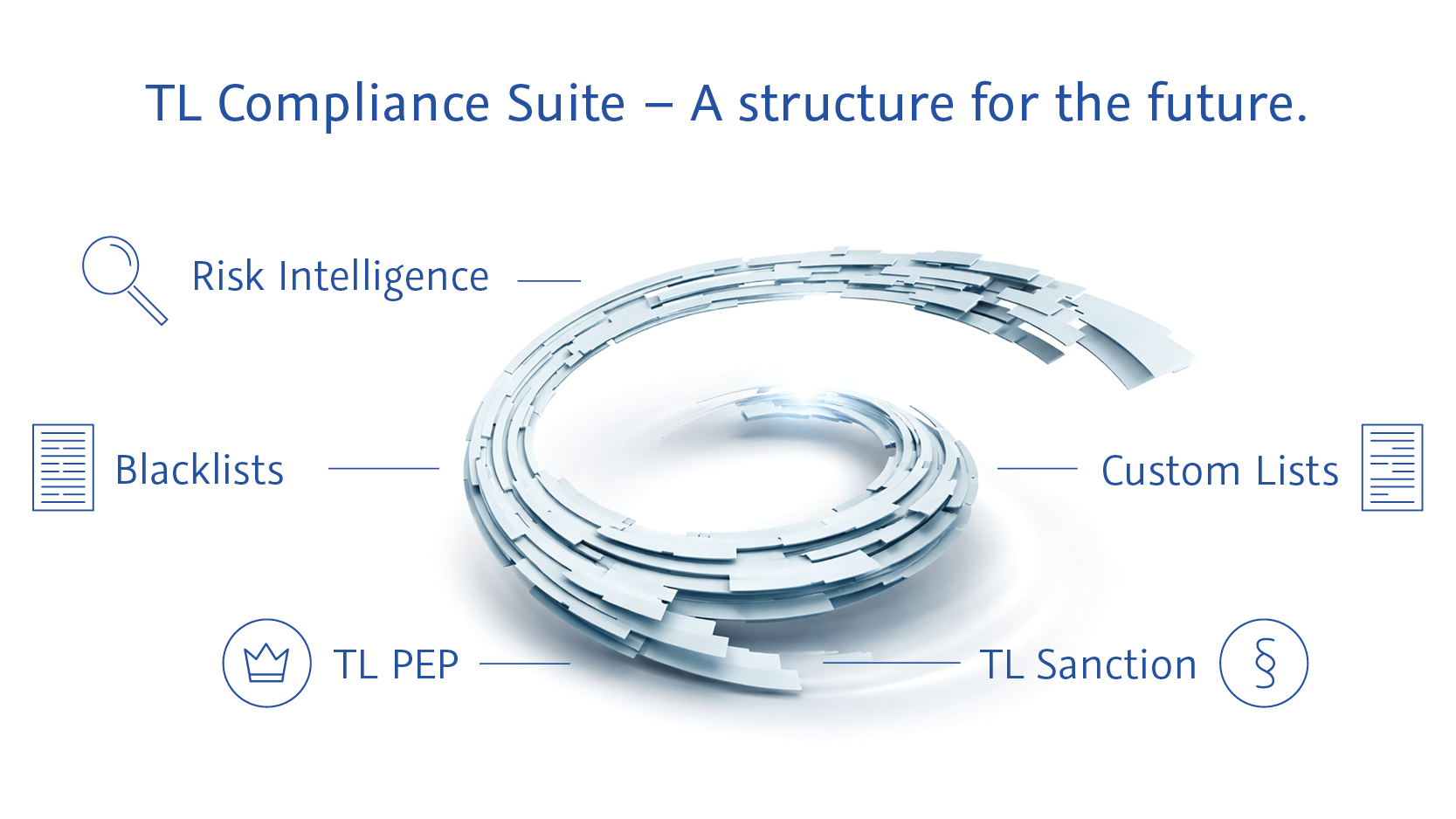
Today, compliance screening is more than just a simple name match or a mere sanctions list check. Companies must reliably screen customers, business partners, suppliers, payees, employees and other relevant entities against sanctions lists, PEP lists, custom lists, blacklists, watchlists, as well as internal and external risk data sources.
This is precisely where the platform architecture of the TOLERANT Compliance Suite comes into its own: it is not just an application for list matching, but a flexible, scalable and integrable compliance platform for various screening procedures, regulatory frameworks, data sources, matching profiles, risk assessments and decision-making processes.
The TOLERANT Compliance Suite combines:
The platform-based approach makes it possible to standardise and automate compliance processes whilst at the same time tailoring them to individual clients, organisational units or use cases — without having to set up separate, isolated solutions. In this way, potential hits and risks are identified, assessed, documented and recorded in an audit-proof manner within a consistent, scalable and robust compliance process.
| Planned AMLR enhancements by the end of 2026
Some of the features described below are currently under development and are scheduled for phased roll-out by the end of 2026. |
The EU Anti-Money Laundering Regulation (AMLR) further specifies the requirements for uniform, risk-based and traceable processes to prevent money laundering and terrorist financing. Financial institutions, banks, insurance companies and other obliged entities must assess customer and business relationships on a risk-based basis, carry out the necessary due diligence, keep information up to date and document their decisions in a way that ensures long-term traceability.
The TL Compliance Suite will therefore be expanded by the end of 2026 to include additional functions for the operational support of these processes. The aim is not only to provide users with data and audit results, but also to guide them systematically through risk analysis, customer due diligence, review, decision-making and documentation.
Assessing customer risks in a traceable manner
A configurable risk assessment model will in future support the structured classification of customers, business partners and other relevant entities. Factors that can be taken into account include customer type, legal form, sector, geographical risks, products, distribution channels, expected business activities, PEP and sanctions results, as well as information on beneficial owners. The risk classification remains transparent and traceable: users can see which factors led to a particular assessment. Manual adjustments, approvals and justifications are documented and archived.
Carrying out customer due diligence using a workflow-based approach
Depending on the risk class, customer type and business transaction, the TL Compliance Suite will in future be able to guide users through the relevant due diligence measures. Configurable checklists, mandatory details, document requirements, tasks and approval steps support standard, simplified and enhanced customer due diligence processes.
In this way, an audit result is transformed into a concrete, structured work process: missing information is highlighted, necessary actions are automatically assigned and decisions are fully documented.
Recording beneficial owners and ownership structures
Complex ownership and control structures often present companies with particular challenges. The planned AMLR extension makes it possible to map direct and indirect shareholdings, beneficial owners, control relationships and relevant corporate links in a structured manner. Relevant individuals and organisations can be included in existing PEP, sanctions and risk assessments. Changes to ownership or control structures are documented in a traceable manner and can trigger renewed review and assessment processes.
Managing reviews, deadlines and follow-ups
The TL Compliance Suite will in future support the risk-based planning and management of regular customer reviews. Review intervals can be set depending on risk class, customer group, product or business situation. Dashboards and task lists show upcoming, pending and overdue reviews, missing supporting documentation and expiring documents. Automatic reminders and escalation processes help to ensure that review obligations are processed on time and in a controlled manner.
Automatically detect and reassess changes
Money laundering risks are not static. For this reason, the existing portfolio monitoring is being expanded to include event-driven review processes. Changes to relevant customer data, new PEP or sanctions findings, changes to beneficial owners, new country-specific risks or suspicious business transactions can automatically trigger a reassessment. This ensures that the risk assessment is not limited to the time of onboarding. Customer information, audit results and measures can be kept up to date throughout the entire business relationship.
Centrally manage and document AML cases
Suspicious activities, verification results and required measures can now be consolidated within a structured AML case management system. Users can review the facts, assign documents and supporting evidence, handle queries, prepare decisions and seek approvals. Every step in the process is recorded in a complete audit trail. This ensures that it remains clear what information was available at any given time, which rules were applied and how a decision was reached.
Provide audit-proof evidence of regulatory frameworks and decisions
Regulatory requirements, internal guidelines and risk models are subject to change. The TL Compliance Suite therefore supports versionable rules, assessment models and process definitions. This means it is possible to trace, even retrospectively, which set of rules was used to carry out a review and reach a decision. This creates a robust basis for internal controls, audits and regulatory reporting.
Business partner and customer screening
Screening of customers, suppliers, partners, payees and other business contacts against relevant sanctions lists, internal risk lists and connected screening sources. The TOLERANT Compliance Suite helps companies to screen new and existing customers as well as business partners on a risk-based basis, to assess potential matches from a technical perspective and to document decisions in an audit-proof manner.
Onboarding screening
Automated screening of new customers, suppliers, partners and other business contacts as part of KYC, KYB, compliance or supplier onboarding processes. Where required, the screening can also be integrated into employee onboarding processes, for example for roles relevant to compliance, international recruitment or particularly sensitive areas of work.
Regular data checks
Periodic checks of existing data sets, for example on a daily, weekly or monthly basis. This ensures that customer, supplier, partner and other master data continues to be monitored even after the initial onboarding.
Ad hoc and special checks
One-off checks of individual datasets or critical data records in response to specific events, such as new risk indicators, regulatory requirements, special approvals or internal control measures.
Payment and disbursement checks
Risk assessment prior to planned payments or disbursements, taking into account hit status, risk indicators, economic relevance and pending transactions.
Extended due diligence checks
In-depth analysis in cases of unclear hits, increased risk or complex ownership, shareholding and control structures.
Risk-based customer onboarding
Even whilst establishing a business relationship, identity, PEP, sanctions, country, sector and shareholding information can be collated and assessed. The planned AMLR support derives the necessary verification measures, documents, tasks and approvals from the identified risk.
Ongoing monitoring of customer relationships
Changes relating to customers, beneficial owners, risk characteristics or verification results can be automatically detected and subjected to a reassessment. Regular and event-driven reviews ensure that customer information and risk ratings remain up to date throughout the entire business relationship.
Handling of suspicious cases
Matches, discrepancies and other anomalies can be consolidated into a central AML case. Audit results, documents, comments, actions, approvals and decisions remain fully traceable.
AML checks in the insurance process
For insurance products, other relevant roles can be taken into account alongside the policyholder, such as premium payers, insured persons, beneficiaries, beneficial owners and payees. Changes to these roles, unusual premium payments, early contract terminations or unusual payout arrangements may in future trigger new review and assessment processes. In this way, the TL Compliance Suite supports risk-based AML controls throughout the entire lifecycle of a business relationship.
Risk-based assessment of business partners and corporate structures
Even outside the financial sector, the TL Compliance Suite supports companies in the structured assessment of customers, suppliers, distribution partners, payees and other business contacts. Sanctions, PEP, country, sector and ownership risks can be consolidated into a single, unified verification process. Tasks, supporting documentation and decisions are managed centrally and documented in an audit-proof manner.
Greater certainty in sanctions list checks
The Compliance Suite also recognises vague, variant or incorrect spellings. This ensures that relevant matches are identified, even if the data does not match exactly.
Reduced manual effort
Regular checks, dataset updates, archiving, hit storage and risk classification can be automated. Your compliance team can focus on the technical assessment of critical cases.
Audit-proof traceability
Every change, every match, every decision and every justification is documented in a traceable manner. This ensures transparency for audits, auditors, supervisory authorities and internal control bodies.
Risk-based decisions
The solution not only evaluates the match itself, but also takes into account additional information such as turnover, payment volumes, country- or sector-specific risks, external risk indicators and upcoming payments.
Flexible integration
The Compliance Suite can be flexibly integrated into existing IT and process landscapes – from cloud- and Kubernetes-based container platforms to existing enterprise systems – and enables the automated, scalable and seamless embedding of screening processes into operational workflows via REST interfaces, data migration, optional BPM integrations (e.g. ITEROP) and an SAP connector, the automated, scalable and seamless embedding of screening processes into operational workflows.

TOLERANT Compliance Suite has been certified with the fair.digital quality seal. This quality seal is awarded to products that combine the principles of data protection, transparency and fairness.
With the TOLERANT Compliance Suite, you are not getting a rigid, stand-alone solution, but a powerful platform for modern compliance screening processes. You can automate recurring screenings, reduce manual effort, improve the quality of hits and create an audit-proof basis for decision-making regarding customer, business partner, payment and onboarding checks.
The combination of fault-tolerant matching, multi-client platform architecture, integrable reference data sources, risk-based assessment and documented decision-making processes results in a compliance screening solution that suits your organisation — both today and in the face of future regulatory requirements. In this way, compliance does not become a barrier to business processes, but rather a reliable management tool for sound business decisions.
The implementation of new regulatory requirements does not begin on the date of application. Data models, risk criteria, validation processes, responsibilities and interfaces must be analysed and prepared well in advance. With the TL Compliance Suite, you can create a scalable foundation for screening, risk-based customer due diligence, ongoing monitoring and audit-proof decision-making.
Talk to us about how your existing compliance and AML processes can be mapped within the TL Compliance Suite, and which requirements should be taken into account today in preparation for the planned AMLR extension.
Discuss AMLR readiness nowTogether, we will analyse your current processes, data sources and interfaces and demonstrate how the planned AMLR support can be integrated into your compliance architecture. |
Note: Some of the AMLR functions described are currently under development and are scheduled for phased roll-out by the end of 2026. The specific scope of functionality and the availability of individual modules may change as regulatory and technical requirements are further defined. The TL Compliance Suite supports the implementation of organisational and technical compliance processes, but does not replace a legal assessment of individual cases.
Every industry and organisation has its own specific requirements for compliance checks. Whether risk-based or standardised and rule-based, the Compliance Suite supports a variety of approaches. Thanks to its multi-client capability, different screening procedures, sets of rules and audit processes can be implemented in parallel within a single organisation.
Integrate your own data sources directly into your compliance audit process. Whether internal watchlists, client-specific risk indicators or additional reference data for specific audit areas: Custom Lists can be easily incorporated into the screening process and combined with existing audit rules.
At the heart of the audit lies the fault-tolerant matching mechanism of TOLERANT Match. This technology identifies relevant matches even when data is not written exactly the same way. This is particularly important for international names, addresses, location details and different spellings.
You need to load content from reCAPTCHA to submit the form. Please note that doing so will share data with third-party providers.
More InformationYou are currently viewing a placeholder content from Turnstile. To access the actual content, click the button below. Please note that doing so will share data with third-party providers.
More InformationYou need to load content from reCAPTCHA to submit the form. Please note that doing so will share data with third-party providers.
More InformationYou are currently viewing a placeholder content from Facebook. To access the actual content, click the button below. Please note that doing so will share data with third-party providers.
More InformationYou are currently viewing a placeholder content from Instagram. To access the actual content, click the button below. Please note that doing so will share data with third-party providers.
More InformationYou are currently viewing a placeholder content from X. To access the actual content, click the button below. Please note that doing so will share data with third-party providers.
More Information